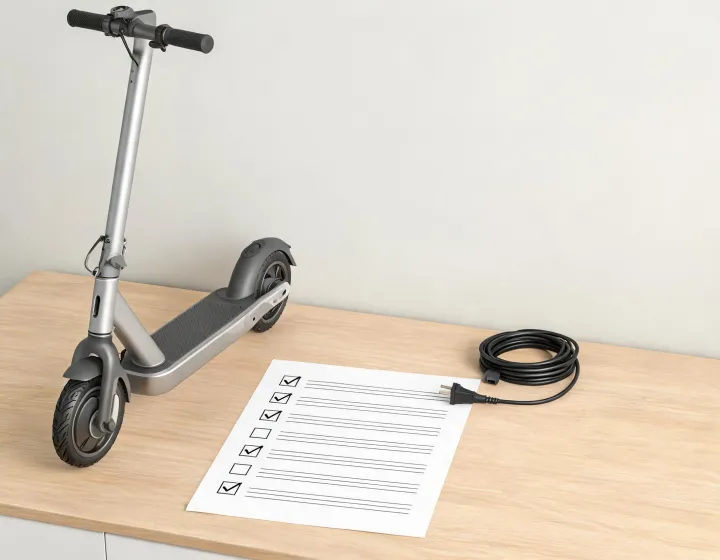
Picture two acceptance files landing on the same desk in the same week. Buyer A treats a supplier's reworked and retested pack as a minor deviation, notes that the voltage matched the original, and lets the shipment move to the next gate. Buyer B stops the same pack at provenance and writes a rejection line he can still defend six months later.
For custom electric scooter work, undocumented rework is a rejection trigger, not a commercial talking point. CPSC's letter to sellers of e-mobility devices sets the reason in one sentence: never use an e-mobility device with a battery pack that has been modified or reworked by unqualified personnel or with re-purposed or used cells. Buyer A's file cannot say who rebuilt the pack or what cells went into it. Buyer B's does not have to.
What a Battery Rejection Rule Changes
The change lands on the checklist, not on the price sheet. CPSC's never-use condition is guidance about the device, not a certificate and not a bargaining position, so treat it as a procurement instruction: provenance first, commercial discussion second.
Most buying teams handle a modified pack the way they handle a paint mismatch: log a deviation, price the concession, keep the shipment moving. That habit works for cosmetics. On a battery it moves the argument somewhere the buyer cannot win, because the file ends up holding a pack nobody can trace and a concession note saying the buyer agreed to it.
The cost of the other order arrives slowly. A reworked pack accepted as a minor deviation goes into inventory, gets mated to a scooter, and ships. When a customer, a retailer's compliance desk, or a lawyer asks who rebuilt that pack, the honest answer is that the supplier said it was fine. That answer does not survive a document request, and the deviation note becomes proof the buyer chose to accept it.
Put Pack Provenance Before Capacity
Ask in a fixed order and weak answers surface early. First question: is this the battery pack the scooter manufacturer recommends for this exact model? CPSC's one-line rule is to use only battery packs recommended by the e-mobility device manufacturer. A custom build makes that harder to satisfy, not optional to check, because someone has to name the pack, and "whatever the factory fits" is not a name.
Second: are the cells new, or repurposed or used? The same letter rules out packs built with re-purposed or used cells, which is exactly the line a custom quote leaves blurry.
Third: which charger is certified for use with this device? Answer that last and you get three separate items on one acceptance line instead of a pack approval that quietly assumes the rest.
Starting with capacity, voltage or range is the mistake almost every team makes, because those are the numbers on the spec sheet and the ones a product manager can actually compare. Run the screen that way and a rebuilt pack clears a performance comparison long before anyone asks about cell history; the provenance question then arrives as an afterthought, at the point where the buyer has already told the supplier which pack they prefer.
Run the three questions in that order and the same pack stalls early, on something the supplier either can put in writing or cannot.
A Passing Test Does Not Clear a Reworked Pack
Most people assume a reworked pack becomes acceptable once it passes a functional check; in fact the never-use condition turns on pack history and on who did the rework, not on a performance pass at the buyer's dock. A pack reading the right voltage and holding capacity after a rebuild tells you it works today. It says nothing about who rebuilt it or what went inside.
If a supplier pushes back, this is where I would spend the argument: a functional pass is not a substitute for provenance, so a pack with no manufacturer recommendation does not get a second review round, it gets a rejection line. Not because rebuilt packs always fail, but because the acceptance file has to stand on its own. There is a boundary on that position. If the scooter manufacturer recommends that pack configuration in writing for that model, the question returns to the ordinary one: does the delivered unit match the recommendation. The gate is the recommendation itself.
The mistake to kill is treating a test pass as acceptance proof. Do that and the file still cannot name the rebuilder or rule out used cells; all it shows is that the pack held together for the length of the check. Require the manufacturer recommendation and the cell provenance declaration before performance review, and the test becomes confirmation rather than a substitute.
Three Battery Candidates and Their Verdicts
Most people assume a custom pack is just another configuration on the quote sheet; in fact the agency that wrote the never-use line treats reworked packs and used-cell packs as a separate category, not a spec preference you can trade against weight or price.
Candidate one is a new pack with a model-specific recommendation from the scooter manufacturer and a charger certification that names the same device. Recommend it, and file the pack identifier next to the recommendation reference so the match is auditable.
Candidate two is a pack reworked by unqualified personnel, or one where nobody will document the manufacturer recommendation. Exclude. That exclusion is not a verdict on build quality; it says the acceptance file would rest on an assurance instead of a source.
Candidate three is a pack built with repurposed or used cells. Exclude outright, and skip the price advantage, because the instruction already removes this pack from the set of things a buyer can approve.
Treating every custom pack as equivalent is the mistake that hides candidates two and three inside candidate one. Once they share a column, the conversation moves to the cost delta and provenance never gets its own line.
Match the Charger to the Pack and Scooter
Only use chargers that are certified for use with the e-mobility device, and only use battery packs recommended by the device manufacturer. Those two sentences belong on the same acceptance line, because a pack decision that ignores the charger approves half a system.
The common mistake is treating the charger as an accessory question, the brick in the box, sourced by whoever had stock. Accept a battery certificate in that arrangement and the delivered set can pair a compliant pack with an uncertified charger, after which the file no longer describes the device that ships.
Hold the set until both documents name the scooter configuration in front of you. This is document matching, not a wiring instruction and not a charging procedure, and nobody on a purchasing team should improvise either.
Write Rejection Into the Purchase Order
Leverage exists before the pack is built and almost none of it exists afterwards. Ask in the RFQ for the manufacturer-recommended pack identifier for the exact model, a written declaration of cell provenance, the charger certification that names the device, and a rejection right for undocumented rework found at acceptance. Wording for that last item needs local counsel; the point is that the item has to exist in the document before the first sample ships.
Assuming "same spec" covers it is the mistake. A phrase like that protects the supplier's position and gives away the buyer's, because a post-inspection fix leaves you arguing after the packs are built, potted and packed. The safety reason for the gate is the never-use condition; the commercial reason is that a rejection right negotiated in advance is cheap, and one negotiated after arrival is not.
Two boundaries I would write down for the team. Testing conditions, tolerances and acceptance thresholds are not in this file and have to come from the model documentation and whatever both sides sign. Rules and standards change, so check the version and the certificate that apply to the exact configuration before shipment instead of trusting a page saved last year.
Buyer A's file is a month old and still cannot name the rebuilder; the deviation note is the only record of the decision, and it says he accepted it. Buyer B's rejection cost one question the supplier could not answer in writing. The gap between those two files is one checklist line added before samples, plus a rejection rule for any pack that cannot fill it.

Leave a comment
Do not include confidential procurement data in a public comment. Use the inquiry form for sourcing requirements.