A buyer can wire a tooling deposit, sign a purchase order and publish a launch date against a scooter whose "2026 compliant" paperwork turns out to describe a proposed rule, or a battery and charger configuration that is not the one on the PO. The money leaves before anyone reads the document closely. Sample cycles restart, launch inventory waits in a warehouse, and the spec sheet has to be rewritten while the deposit is already gone.
The June 2026 battery notice is an RFQ boundary document, not a certificate you can print on a listing. Used correctly, it tells a US sourcing team which questions to put in writing before tooling starts. Used as a badge, it produces claims nobody can trace to a document, a version or a scooter configuration.
A Wrong 2026 Compliance Claim Costs Real Money
Picture the failure mode without any invented test data. A supplier sends a spec sheet stamped "2026 compliant." The buyer reads it as federal approval, approves the sample, releases a tooling deposit and books a container. Months later someone asks which document the claim rests on and gets back a link to a proposal still open for comment. The scooter never changed; only the reading of a word did.
The cost chain is ordinary procurement arithmetic. Tooling and PO commitments are hard to unwind. Sample-approval cycles repeat when the configuration has to be re-documented. Launch inventory sits while a compliance narrative is rebuilt. None of that requires a bad product; a misread document is enough.
That is why the status line matters more than the compliance word. A buyer who knows the June 2026 notice is a proposal asks a different first question than a buyer who assumes a mandatory standard already exists. The second buyer is negotiating price on a scooter whose compliance story is still being written by a regulator.
What the 2026 Battery NPRM Actually Is
On June 24, 2026, the Commission published a notice of proposed rulemaking in the Federal Register, proposing to issue a safety standard for lithium-ion batteries used in micromobility products under the Consumer Product Safety Act, and seeking written comments. That is the document in one sentence: a proposal, published, open for comment.
What it proposes is narrower and more specific than "a scooter safety law." Electrical systems using lithium-ion batteries in micromobility products would comply with applicable voluntary standards, with modifications. The mechanism is incorporation of voluntary standards plus changes, not a fresh technical rulebook written from scratch.
Read the status before the adjective. A proposal is not a final mandatory rule. A supplier's certificate issued today cannot certify against a requirement that has not been finalized, and a buyer cannot treat an NPRM citation as an enforceable federal standard for the scooter on the water.
This is also not the same animal as CPSC's earlier letter to industry, which urged manufacturers, importers, distributors and sellers of consumer micromobility devices to ensure their devices were designed, manufactured and certified for compliance with the applicable consensus safety standards. That letter is a compliance call pointing at consensus standards. The 2026 NPRM is a rulemaking proposal with its own procedural life. Mixing the two produces the sloppiest sentence in scooter sourcing: "we are 2026 certified."
The letter's substance still deserves attention, because it names certification against applicable consensus safety standards as the expectation for devices sold in the US. Which standard applies to a given scooter's electrical system is a separate question that has to be answered per model and configuration, not settled by a phrase on a spec sheet.
Four Boundary Questions Before You Trust a Claim
Start with the document itself. Does it say proposed or final, and who issued it? If the answer is a proposal from a regulator, the claim stops being a certification and becomes a lead. If nobody can name the issuing body, there is nothing to evaluate yet.
Then narrow to coverage. Which electrical system and battery configuration does the document actually address? A standard aimed at lithium-ion battery electrical systems in micromobility products does not automatically cover every pack, charger and controller combination a factory can build, and it does not cover a scooter just because the scooter is electric.
Next, ask what proves that configuration. Which certificate and which report version tie the battery, charger and electrical architecture on your drawing to a tested assembly? A certificate for a different pack is not partial credit for yours; it is not evidence for this build until someone shows the link.
The last question is the one that survives the others. Who will put the current version and scope in writing, for this model, before the order? Verbal assurance, a slide and a chat screenshot all fail at the same moment: when a retailer, an importer or a claims reviewer asks for the document behind the claim.
Three Custom Scooter Scenarios Where Status Changes the Answer
Suppose a retail custom scooter arrives with a supplier claim of "2026 compliant" and no document status. The claim is a lead. The buyer's move is to request the underlying document, its status and its issuing body before the claim enters any listing, spec sheet or sample approval record.
Now imagine a private-label program where the only support offered is a web page describing a standard. A web page is marketing, not a certificate scoped to a model. Until a document with a version and a configuration shows up, the program sits at partial evidence and the RFQ should carry the open question in writing.
Consider a third case: an existing certificate presented for a scooter whose battery or electrical configuration has changed for the US build. The certificate belongs to the earlier assembly. It becomes out of scope for the new configuration unless the supplier can show the same battery, charger and electrical system are covered, which is exactly the point where a cheap substitution gets expensive.
Three situations, one habit. Classify each claim as lead, partial evidence or out of scope until status and configuration are written down. Nothing in that classification requires a lab or a test report of your own; it requires reading what was sent and noticing what it does not say.
The RFQ-to-Sample Review Workflow
Lock the configuration first: the scooter model, the battery pack, the charger and the electrical architecture intended for the US market, written into the RFQ as the reference build. Every later document question hangs off that reference. Without it, a supplier can answer accurately about a scooter nobody is buying.
Then ask for the paperwork in named form. Which standard, which version, which certificate scope, and does it cover this model, this battery and this charger? Before you get too excited about a fast reply, put the claim in writing and see whether it survives being read back.
Require the document's status and issuing body in the same response. Proposed or final, and from whom. A supplier who cannot state the status has not read the document, and a supplier who will not state it is telling you something about how the rest of the file will look.
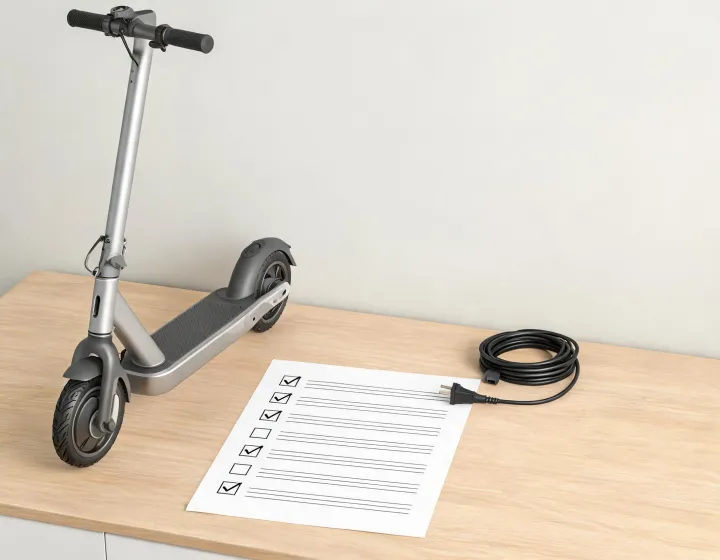
Turn every missing item into a written RFQ question rather than an assumed spec. Unanswered questions stay visible on the tracker; they do not get quietly converted into a line on the spec sheet because the launch date is close.
Approve samples against an agreed checklist and record what remained unresolved at approval. That record is what protects the buyer when the configuration drifts, because it shows which items were open on the day the sample passed.
Before the PO, check that nothing in the file has drifted: same document, same version, same build. Rules move and standards get revised, and a file that was accurate at sample approval can be stale by the time tooling is released. Test conditions, tolerances and acceptance thresholds belong to the specific model documentation and whatever the two sides agree in writing; nothing in this workflow substitutes for that.
One Check Before the Purchase Order
Hold the PO until one written statement lands: the exact standard version and certificate scope for this exact scooter model, battery and charger configuration, plus whether the cited document is proposed or final. One statement, tied to the build on the drawing, from someone accountable for it.
That single check earns its place because it collapses the two ways a compliance claim fails. Either the document is a proposal dressed as a rule, or it is a real certificate for a different configuration. One statement naming version, scope, configuration and status exposes both, while the tooling deposit is still in your hand.

Leave a comment
Do not include confidential procurement data in a public comment. Use the inquiry form for sourcing requirements.