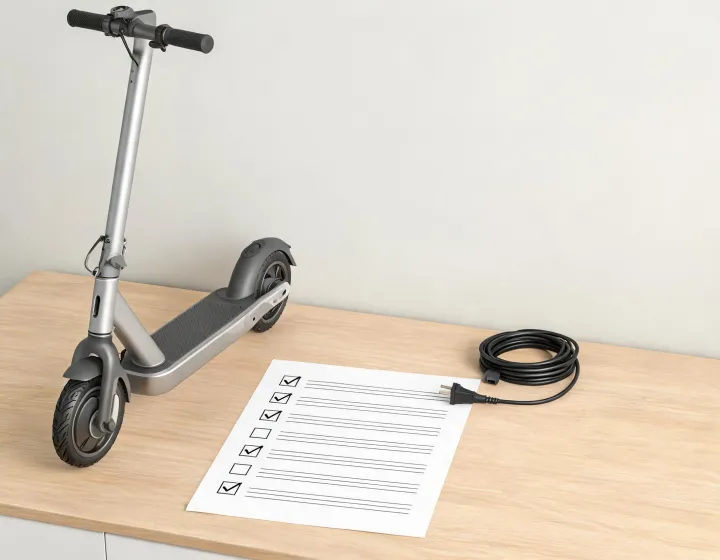
A line in a US micromobility safety letter tells operators to use only chargers certified for use with the device and only battery packs recommended by the device manufacturer. The line I see most often in a custom electric scooter RFQ asks for the plug type and the output voltage. Those two requests barely touch. A plug specification describes a connector; it says nothing about whether a charger, a pack, its cells and the scooter were qualified as one working set.
That mismatch is what makes the charger section of an RFQ worth rewriting. A supplier can answer the plug question completely and still leave every compatibility claim unproven, and the buyer will not notice, because the reply looks finished. The questions below are built so that a thin reply marks itself as thin.
Answer the System Question Before the Plug Question
The opening question is not about the charger. It asks how the electrical system was qualified as a whole. The CPSC letter to micromobility stakeholders describes the manufacturer's method this way: "They use a system approach to ensure that all electrical system components, i.e., micromobility device, battery, cells and charger, are compatible and function safely together." Treat that sentence as a cast list: device, pack, cells, charger. An answer that names only the charger has left most of the system out of the reply, and the omission is visible without any electrical engineering background.
A usable RFQ line reads: for model X, identify the charger model, the pack part number, and the cell format and source you qualify together, and name who ran that qualification. One sentence, three identifiers, one accountable party. A reply that returns a charger data sheet and nothing else has just told you which of the three it can speak to.
Matching runs on more than fit. A charger is expected to deliver current the pack's bill of materials was sized for, stop charging at the right point, and behave predictably when the pack is hot or deeply discharged. Plug geometry and a nominal voltage figure sit at the shallow end of that list, which is exactly why they are the easy answer. The shallow end is cheap to answer and proves the least.
Write the Charger Line as a Certified Pair
Certification carries a scope, and scope can be read. The same letter instructs users to use only chargers certified for use with the device, and the phrase for use with is doing the work: it binds a certificate to a named device. A safety mark moulded into a housing binds nothing on its own.
Change the ask from "is the charger certified" to "send the certificate page whose scope names model X and the pack part number." The effect is mechanical. A scope page either lists the model or it does not, so the reply stops being a verbal assurance and becomes a file you can keep next to the purchase order and hand to whoever asks later. A question about certification gets an adjective; a question about a scope page gets a document.
Three reply shapes recur and each can be spotted in seconds: a certificate for a different model in the same family, a photograph of the connector, and a statement that the factory holds a general quality management certification. All three are verifiable in form and empty in content. None of them tells you the charger was certified for the scooter you are buying.
Tie the Battery Recommendation to a Document
The letter is equally direct on the pack: "ONLY use battery packs recommended by the e-mobility device manufacturer." On a custom build the useful question is who that manufacturer is. The name on the device is usually the brand owner, while the pack may be specified by the factory building to that brand's requirement. Fix the issuer in the RFQ before asking for the recommendation, or a reply from the wrong party will read like authority.
Then ask for the recommendation as a document with the device model, the pack part number, a revision, and an issue date. A verbal "our packs all work with this controller" is a sales position, not a recommendation. If the file arrives without a revision line, keep the item open instead of closing it on a phone call, because a pack revision can change without the model name changing.
I have no recommendation file and no certificate set from a supplier in front of me for this article, so nothing here invents a part number or a qualification date. What the section fixes is the shape of an answer that would count, so that anything arriving in a different shape stays visibly unfinished.
Run Every Reply Through the Same Checklist
Suppose two suppliers answer the same RFQ. Supplier A returns the certificate scope page for a different model and says so in the covering email. Supplier B returns a few lines saying the charger fits every scooter in the range, plus a photo of the connector.
On a document heading for a production order, I would take A's refusal every time. The refusal tells me where the scope ends and lets me change the model or change the supplier; B's few lines tell me nothing I can check at shipment and cost me a second round of questions anyway. The preference holds only for PO-bound paperwork — someone replacing a single charger for a personal scooter gets real value from a fast "it fits" reply, and a scope page is overkill for that.
The checklist I run over each reply has one line per claim: which device model is named, which pack part number, which charger model, which certificate scope, who issued the battery recommendation, and which of those arrived as a file rather than a sentence. I check the reply against the RFQ line by line instead of reading it top to bottom, because a chatty reply conceals missing items well. I noticed that gaps rarely appear as blanks. They appear as adjacent information: a plug photo where a scope page was requested, a factory tour offer where a revision number was requested.
In a batch of replies I reviewed, the same charger model came back quoted against several different pack capacities with no note about current settings. I cannot tell from those documents whether that is fine, and that is the whole point — an unstated condition is an unanswered question, and it stays open.
Keep Sample Approval Separate From Production Claims
Sample approval and production approval are different documents with different coverage, and an RFQ that blurs them will be read as a production commitment the first time a sample passes. Say which unit the approval covers: build or serial number, configuration version, pack part number, charger model. Without those identifiers, "sample approved" means one object was looked at once, on one day, by someone.
Name the changes that void the approval. A different pack part number, a different charger model, a different cell source or format, a changed battery management configuration — each can move the system away from whatever was qualified. Writing those triggers into the RFQ moves the argument to the quoting stage instead of a later shipment, when tooling is already paid for.
Two limits apply to this section. No sample has been tested for this article and no factory has been audited, so it stops at document questions and contract language. And a sample whose connector seats properly proves fit, which was never the question being asked.
Re-verify Scope and Standard Version Before Shipment
The letter supplying the instructions used here is a CPSC document carrying an earlier compliance call and safety guidance. It does not make every relevant standard federally mandatory, and its scope has to be read per standard — the device standard and the e-bike standard are separate — with later proposals checked on their own terms. A web page or a regulation citation is not a product certificate, whatever it claims.
An RFQ reply is a snapshot taken on the day it was written. Record what was verified and when: standard edition, certificate number and scope, pack revision. Agree in the RFQ which events force a fresh check — pack resourcing, a charger model change, certificate renewal or withdrawal, a configuration change — so a batch shipping later is not carrying an old answer into a new customs file.
If you are hunting the cheapest replacement charger on a marketplace and nobody will ever ask you for a compatibility file, this line of questioning is overhead you do not need. If you are signing a PO against a custom scooter and someone downstream will ask you to show that charger, pack and device were qualified together, then the unanswered lines stay unanswered until a document closes them, and you should not close them on the supplier's behalf.

Leave a comment
Do not include confidential procurement data in a public comment. Use the inquiry form for sourcing requirements.