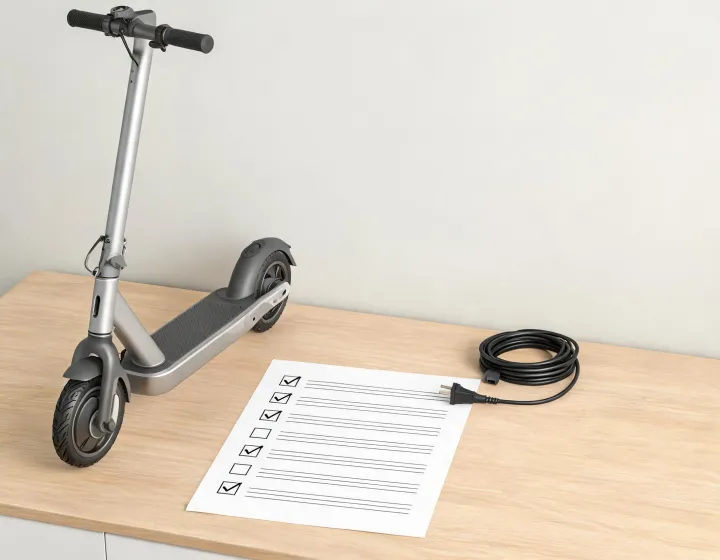
How should you inspect the controls and folding hardware on a custom electric scooter? Work from the joint outward: seat and lock the stem, confirm the folding-structure hardware is tight, then test throttle return, the brake light, both indicators, wheel spin, and motor sound. The documented reference here is the Ninebot KickScooter F2 and F2 Plus, US models 051201U and 051202U.
A custom build shares the physics with that scooter but not necessarily the hardware. Same order, different fasteners, different latch, different switchgear. Map each step onto whatever your own paperwork names before you tighten or twist anything.
Begin With the Folding Joint
The F2 manual lays the folding sequence out in plain order: unfold the kickstand, unfold the handlebar stem, close the quick-release lever. Then comes the part most owners skip, which is tightening the screw fixed with the front fork and screwing in the core-position screw of the folding structure, reachable once the stem is folded.
Treat that joint as its own checkpoint, finished before you touch the throttle or the brakes. The reason is consequence, not convenience: every electronic function can test clean while the structure carrying your weight is still loose, and the electronics cannot tell you about it. F2 screw sizes and torque figures stay with the F2; a custom deck or stem can use entirely different hardware, and copying a number across is how people strip threads on a machine nobody has parts for.
Confirm the Quick-Release Lever Stays Closed
A quick-release lever holds by friction and preload, not by shape. Close it and the clamp squeezes the stem; leave it part-way and you get the look of a locked scooter with far less clamping force than the joint was built around. That is why a glance at the lever is not a check. The lever can sit close to its closed position without being closed, and the difference is load, not appearance.
The confirmation points in the manual are specific: lever closed, folding-structure screw tightened, with that screw only reachable after folding. Run the same two-part confirmation on your own machine, latch in its locked position and joint hardware tight, and find the locked position in your own manual if your build uses a collar, a pin, or a cam instead of a lever. If you cannot point to the part of your paperwork that shows what locked looks like, you have an open question about your scooter rather than a pass. Comparing folded and unfolded states is where a shift shows up.
A joint that passes on day one can still work loose in service. The manual makes checks a recurring owner duty rather than a one-time unboxing step, which means the useful habit is the same short pass repeated at whatever interval your own paperwork names, not one thorough session that never repeats.
Test Throttle Return Before Any Road Test
Throttle test, F2 version: press and hold the throttle, release it, and check that the scooter accelerates and decelerates as expected. Then the step the manual writes out separately, which is releasing it and confirming the throttle backs to its position.
Return-to-idle earns its own line because a throttle is a continuous torque request, not a switch. The controller reads grip position, so while the grip sits partly open the request keeps arriving even though the rider is certain they let go, which means rider intent and scooter input can disagree.
Here is the tradeoff I would hold to on any scooter, custom or not. Acceleration feel is a preference, soft or snappy or jerky off the line, and most riders adapt inside a week. A throttle that does not come back is not a preference you learn around. That reading comes from the F2 steps splitting return away from acceleration into its own check. Your machine may use a thumb lever or a twist grip, yet the pass condition does not change: it returns on its own.
Check Brake Light and Direction Indicators
The brake light check is the simple one: squeeze the brake lever and confirm the taillight works normally. Then the indicators, toggling the button left and then right, confirming the matching side flashes rather than the wrong side or nothing at all.
Group them because they share the rider-control layer, lever switch, harness, and the electronics driving the lamps. A taillight that never lights can trace straight back to the lever switch sitting upstream of the lamp, and a one-side-only indicator points to a switch or a circuit long before it points to the lamp itself. On a custom scooter with aftermarket lighting there are simply more places for that chain to fail. What you want out of this pass is a recorded pass or fail per function, so an intermittent fault arrives at the shop with a history instead of a shrug.
Spin Wheels and Listen to the Hub Motor
Spin the wheels and watch the caliper: it should sit aligned with the rotor, with no rub on the brake pads. Then the motor check, accelerating and decelerating while you listen for a hub motor that stalls or makes abnormal sounds. The F2 step stays general about test surface, so treat that as an open item to confirm before the motor result counts.
Alignment ties both checks together. The stem, the folding joint, and the wheel and brake mounts sit in one load path, so a joint that never fully seated can push the caliper a fraction off the rotor or leave the motor working against drag. It comes back to geometry: the symptom surfaces as brake rub or a strained sound rather than as obvious play at the handlebar. A rub that appears only after you unfold is telling you about the fold, not about the pads.
Picture the same scooter after a season of daily folding and unfolding, the pattern a shared fleet sees far sooner than a single owner. The checks do not change; what changes is how much a borderline result costs you.
Separate Owner Checks From Service Center Work
The manual puts regular checks on the owner and names an authorized service center for inspection and service. That division is worth copying onto a custom build, with your own list of user checks as the boundary line.
In practice the line runs like this. Confirm what your paperwork lists as an owner check, write down what you see, and stop there. If a fastener will not stay put after tightening, a latch will not sit in its locked position, or a control works sometimes and not others, that belongs with a service center, because those findings need the machine in front of someone holding the right parts. Reading a fault is a buyer's job. Chasing it into the wiring of a scooter you unboxed yesterday is not, and no article, this one included, should hand you a repair sequence it cannot source for your model.
Before the first ride, the one item worth insisting on is the folding joint itself, not the electronics above it. Every other check on this list gives you a symptom you can see while parked. A joint that sits between your hands and the front wheel gives you nothing to see until it changes how the scooter steers or brakes.

Leave a comment
Do not include confidential procurement data in a public comment. Use the inquiry form for sourcing requirements.