-
Day One Starts With the Whole Electrical System
-
In the First Week, Ask for Accredited-Lab Certification
-
Three Weeks In, Walk the Reply Down Your Checklist
-
What the RFQ Still Cannot Tell You About Downtime
-
By the End of the Month, Compare on One Sheet
-
Before the PO, Re-Check the Rules and the Certificate
It is a Monday morning, and there are three supplier quotes for a custom electric scooter open on my desk. Each one says the battery is certified. None of them names the charger, and none names the scooter that pack ships with. That is the moment a sourcing document stops being a shopping list and turns into a compatibility checklist.
The electrical-system section of a custom scooter RFQ should make every supplier name the device, the battery, the cells and the charger as one combination, and back that combination with a certificate that names it. Without that, the replies cannot be compared on safety, and they cannot be compared on downtime either.
Day One Starts With the Whole Electrical System
Day One is about the first draft, before any supplier has replied. Three things get pinned down on the page: what the scooter is for, which market it will be sold in, and the exact combination of device, battery, cells and charger, written as a single line rather than four separate ones.
Intended use is not decoration. A scooter bought for adult commuting on public roads and one bought for a closed campus carry different expectations, and the RFQ should say which one you are buying so that the reply answers for that use instead of for a generic scooter.
The reason for the single line is not paperwork. The Consumer Product Safety Commission describes what it expects in plain terms: "They use a system approach to ensure that all electrical system components, i.e., micromobility device, battery, cells and charger, are compatible and function safely together." Compatibility belongs to the set, so the question has to be asked about the set.
Suppose the draft lists a battery specification on one line and a charger specification on another. A supplier can answer yes to both and never say whether the two were ever evaluated as a pair. The buyer then compares four sets of yes answers and calls it a comparison.
In the First Week, Ask for Accredited-Lab Certification
Somewhere in the first week, the certification request needs wording that produces a reply you can check. The same CPSC letter urges recipients to ensure that "the micromobility devices for consumer use that you manufacture, import, distribute, or sell in the United States have been designed, manufactured, and certified for compliance with the applicable consensus safety standards." It adds that "Compliance with the standards should be demonstrated by certification from an accredited testing laboratory."
Put that in the RFQ as a document request, not as a promise about performance. Ask the supplier to say which standard applies to the device itself and which applies to the battery, cells and charger set, and to show a certificate whose scope covers that exact configuration.
Write the request so that a yes has to arrive with an attachment. If the reply is a sentence about the factory instead of a document about the combination, you have learned something useful about the reply, though not yet about the scooter.
Keep the boundary visible while you do it. The letters carry a compliance call and safety guidance, and they do not turn every consensus standard into mandatory federal law. That distinction matters the day a supplier sends a certificate and you have to explain to your own team what the document does and does not prove.
It also shapes the follow-up you send. "We hold certificates" deserves another question rather than a tick in the box, because the useful information is which certificate covers which combination.
Three Weeks In, Walk the Reply Down Your Checklist
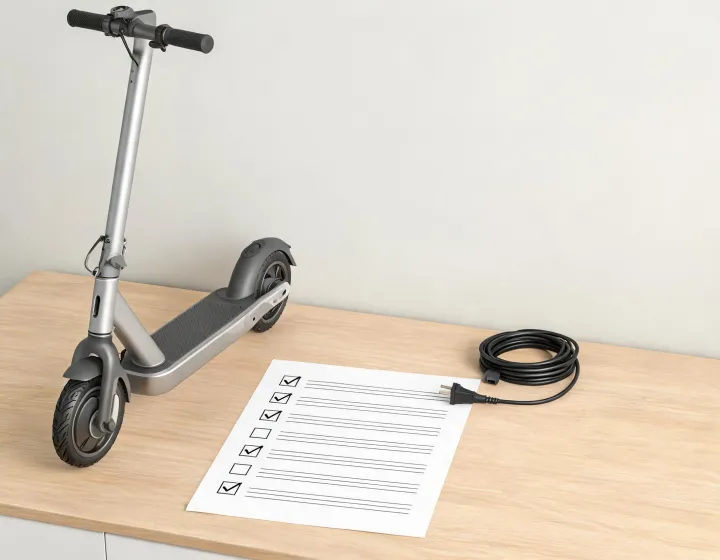
Three weeks in, the replies are back and the work is mechanical. You just walk each reply down your checklist, line by line. Does it name the exact battery, the cells and the charger together with the device? Does the certificate scope match that same combination? Which line was answered by a brochure sentence instead of a document?
The third question is the one people skip, and it is usually where the gaps sit. This part is not glamorous, but it saves you a lot of grief later. Turn every vague line into an open RFQ question, send it back, and note what came back and when.
A reply counts as complete only when each required line is answered by a document that names the configuration, not by a general statement of capability. That test is simple enough to hand to a colleague: if two people read the same reply and cannot both point to the same document for the same line, the line is still open.
What the RFQ Still Cannot Tell You About Downtime
A compatible set tells you something about safety. It tells you very little about the cost of keeping scooters on the road. Spare charger availability, battery replacement cost and service intervals are separate questions, and nothing in this round of documents answers them. Put them in the RFQ as written questions and leave them marked unanswered until a supplier replies in writing.
Ask, for example, how a spare charger is identified and how a buyer confirms that it matches the pack that was quoted. That is a sourcing question you can put on paper today, and the answer belongs in the same row as the certificate.
None of this is a reason to hold the RFQ back. It is a reason to keep maintenance questions in the same document as the electrical ones, so the answers arrive together and the quote can be read as a whole.
Suppose two quotes come back at the same unit price. The buyer comparing only that number is pricing the purchase, not the downtime that follows it. The configuration question does not go away after the order; it comes back the first time something needs replacing.
By the End of the Month, Compare on One Sheet
By the end of the month you should be comparing configurations, not suppliers. Build one row per configuration, with columns for the standard cited, the certificate scope, the document status and the open questions. Replies that describe different combinations go on the same row only when the parts actually match; otherwise they are marked not comparable before anyone looks at price.
This is where the system view earns its keep. A row that pairs one supplier's charger with another supplier's pack is not a cheaper option, it is a different question, and the comparison quietly stops meaning anything.
Keep one owner for the sheet and one version of it. When a supplier sends an updated document, the row changes and the change gets a date. A comparison that lives in four inboxes is not a comparison.
The sheet also keeps the boundary honest. If a supplier left some lines unanswered, the row shows them as open questions instead of a green tick, and nobody has to reconstruct that later from memory.
Before the PO, Re-Check the Rules and the Certificate
Rules and standard versions move. The 2023 letters rest on an earlier compliance call, and later proposals can shift the picture again, so the check you ran in the first week is not the check you run before the purchase order. Confirm which standard version is currently effective, and confirm that the certificate scope still names the exact configuration you are buying.
One boundary belongs in the file: a web page or a citation to a regulation is not a compliance determination for a specific product. It tells you which question to ask. The answer comes from a document issued for the configuration you are ordering.
The objection I hear here is fair. The supplier is a large factory with a thick folder of certificates, so is this not overkill? It is a different question rather than an excessive one. A certificate that does not name the exact configuration is not an answer to your RFQ, however impressive the folder looks. Either get the configuration-specific document, or record the quote as not comparable and carry that fact into the buying decision.

Leave a comment
Do not include confidential procurement data in a public comment. Use the inquiry form for sourcing requirements.