-
The Throttle Release That Won't Slow Your Scooter
-
Get the Scooter Out of Parking Mode First
-
Pick Your Speed Mode Before Cruise Engages
-
Two Inputs End Cruise Mode and Both Beep
-
When the Reflex and the Scooter Disagree
-
Check Throttle Return Before Each Fleet Shift
-
What These F2 Instructions Can't Tell You
A rider gets the scooter up to speed on a clear straight, lets go of the throttle expecting it to coast down, and it keeps going. That is not a fault on the Ninebot KickScooter F2 series: the scooter will not decelerate when the rider releases the throttle for the first time upon entering Cruise Mode. In fleet terms the moment costs more than the surprise — one rider who grabs for a brake that was never the plan turns into a near-miss report, a unit parked for the rest of the shift, and an argument about who signed off the training.
The instinct to fix this with a softer throttle hand is the wrong instinct. Cruise mode on this scooter is an exit skill, and the brake lever plus a second throttle press are the controls that end it, which is why the rider who plans the exit before engaging is the one who stays out of trouble. Everything below stays inside the Ninebot KickScooter F2 series as described in the OEM manuals, including the US model codes 051201U and 051202U where those documents name them.
The Throttle Release That Won't Slow Your Scooter
Release the throttle the first time after cruise engages and the scooter keeps its speed. The reason is not a sticky grip or a lagging sensor. A cruise function works by latching a speed setpoint in the controller; once that value is held, the throttle becomes a command input rather than the thing that sets speed. Letting go removes the input and leaves the setpoint standing, which means the scooter's speed is now governed by state rather than by the rider's hand.
That distinction is where near-misses start, because every other throttle a rider has used — a rental kart, a mower, the scooter they rode last year — behaves the opposite way. The reflex that release equals slow-down is trained into people long before they stand on an F2. A rider whose hand comes off at speed and feels no change has about a second of confusion before deciding what to do, and the choice made in that second is the whole safety story of cruise mode.
Get the Scooter Out of Parking Mode First
Nothing about cruise control is available until the scooter is actually moving. On the F2 series the rider has to exit Parking mode by squeezing the brake lever once or accelerating above 1.86 mph (3 km/h) before riding. From there the start is human-powered: stand on the footboard with one foot and push off with the other to start gliding. The motor will not engage until the scooter reaches 3 km/h (1.9 mph), and on the models that support it the start speed can be set between 0 and 3.1 mph (0–5 km/h) in the Segway-Ninebot app.
Those two numbers do different jobs, and mixing them up wastes a training session. Parking mode is a state the scooter sits in; the 3 km/h motor threshold is a rolling condition that has to be met on every start. Because the motor is inhibited below that threshold, the opening seconds of every ride are legwork, which means cruise mode can only be reached after the scooter is already rolling. The working order that falls out of it is park-mode exit, then push-off, then throttle — and a rider who tries to skip the middle step simply stands there with a dead motor.
Pick Your Speed Mode Before Cruise Engages
Speed mode is a pre-ride decision, not a mid-cruise adjustment. With the scooter on, a single press of the button switches the headlight and rear light, and a double press switches between speed modes. Nothing in that control path is built to be worked while the scooter is holding a latched speed, and reaching for the button with one hand while the other has already left the throttle is exactly the moment a rider loses track of which state the machine is in.
What the choice really comes down to is this: cruise holds whatever the scooter was doing at the moment it engaged, so the mode in force when the rider sets off is the mode cruise will hold. Read that as a working inference rather than a printed specification — the manual passages used here describe mode switching as a button action taken with the scooter on, and they do not spell out the engagement condition in the same breath. The effect is the same either way. Choose the mode while stopped or at walking pace, before the scooter is holding a speed you did not choose.
Two Inputs End Cruise Mode and Both Beep
Cruising ends when the rider squeezes the brake lever, or re-presses the throttle after releasing it, and the buzzer rings two short beeps. Those are the only two rider inputs that count. The reason a re-press is needed at all is that the throttle has already been released — once the grip is back at rest, the only throttle-side event the controller can still tell apart from cruising is a fresh press, which is why a rider who eases the throttle back on gently and holds it there has not ended anything.
Treat the two beeps as the confirmation, not as decoration. A rider who never heard them is still in cruise mode no matter what their hand did, and that is the single most useful line a supervisor can put in a five-minute briefing: your hand is not the indicator, the sound is. It also gives an operator a cheap check during a ride-along — count the beeps on every exit and the drill either happened or it didn't.
When the Reflex and the Scooter Disagree
Suppose a rider is cruising a straight stretch at a steady speed and a driveway apron comes up on the right. The hand comes off the throttle the way it would on any other machine, the scooter holds its speed, and the recovery now has to come from the brake lever. That is a picture of the failure, not a report of an incident, and it is worth putting in front of a new rider precisely because nothing in it is dramatic — no fall, no collision, just a second of the wrong reflex at the wrong moment.
The habit that closes the gap is brake first, then decide. Because the throttle release is neutral at engagement while the brake is the documented exit, a rider who treats the brake lever, not the throttle, as the first move through a cruise stretch has already converted the reflex into the right one. Sequence matters more than pressure here: the same squeeze ends cruise and starts braking, so the scooter is under the rider's control on the way into the hazard instead of after it.
Check Throttle Return Before Each Fleet Shift
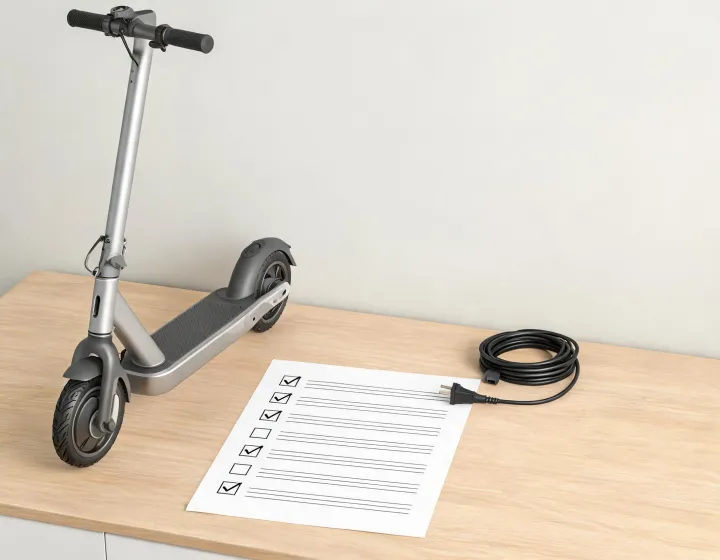
Per-vehicle checks beat per-rider trust once a fleet gets past a handful of units. The manual's own throttle check is simple: press and hold the throttle, release it, and watch for acceleration and deceleration; on release, confirm the throttle backs to its rest position. Run it on the stand before a shift and you learn two things at once — whether the motor responds and whether the grip returns cleanly.
Throttle return is the check that protects the cruise procedure, because the documented exit relies on a fresh press being distinguishable from a held one. A grip that comes back slowly, or stops short of rest, is the one hardware condition that makes the exit unreliable, which means the rider may be pressing into a throttle the controller already reads as partly open. Rather than trust that every rider will notice a lazy throttle on their own, put a hand on it before the shift and watch it come back — with the caveat that the manual passages used here set no check interval and no rejection threshold, so the schedule is the operator's own policy rather than a manufacturer requirement.
What These F2 Instructions Can't Tell You
Every fact here is bounded to the Ninebot KickScooter F2 series as documented in the OEM manuals, with the US model codes 051201U and 051202U named where the source names them and the app-set start speed limited to the model codes that app section lists. None of it transfers to another controller or to a custom build running aftermarket firmware. A scooter that looks the same and behaves differently when the throttle is released is a different machine with a different manual.
The passages used here also stop short of the engagement condition itself — how long the throttle must be held to enter cruise, or whether an app toggle is involved, is not stated in what we have. Instead of inferring a hold time from feel, read the manual for the specific unit, and if it is silent, put the question to the supplier in writing. Because the exit rule leans on how that particular throttle returns, any scooter with a differently designed throttle needs its own documentation before the same habit is safe to teach.
This routine is not for someone running an aftermarket controller or a scooter outside the documented F2-series scope, because the whole exit rule is tied to a throttle the manual actually describes. For a documented F2-series unit in a commuter or delivery fleet, brief riders on the brake-first exit and check throttle return before the shift; for anything else, that unit's own manual comes before any habit borrowed from here.

Leave a comment
Do not include confidential procurement data in a public comment. Use the inquiry form for sourcing requirements.